2026
Astronomical Calendar
This supplement to Moon Guy Next Door’s wall calendar dives deeper into the best astronomical events of the year and how to observe them.
Scroll down for all the juicy details, or order your calendar on The Moon Guy Shop
Table of contents
January |
Back to top |
Is it easy to see?
💙 = Easy
💛 = Medium
❤️️ = Challenging
💙 January 3, PM: Full moon meets Jupiter, Castor, Pollux
What: The full moon meets with Jupiter, the king of the planets, and the brightest stars in Gemini, Castor and Pollux
When: Saturday January 3, starting approx. 1.5 hours after sunset
Equipment needed: Naked eye or binoculars (recommendations: Cometron 7x50)
How: The full moon will rise toward the northeast around the time of sunset, but you’ll need to wait a few minutes to see Jupiter close to it, and the stars of Gemini will only become visible about an hour and a half after sunset. They will rise higher in the sky for a few hours and keep making their way west until they set in the northwest around the time of sunrise.
💙 January 22, PM: Moon meets Saturn
What: The waxing crescent moon meets Saturn, the ringed planet
When: Thursday January 22, approx. 1 hour after sunset to 4 hours after sunset
Equipment needed: Naked eye
How: Wait until darkness, at least an hour after sunset. Find the moon toward the southwest. Beside it, you’ll see what looks like a bright star, which is actually Saturn. They may not be close enough to see them both together with binoculars, but if you have binoculars, Neptune is in the same field of view as Saturn. They will get even closer together in February. Check below for more information about that encounter.
💛 January 27, PM: Moon meets Pleiades
What: The waxing gibbous moon meets with the Pleiades star cluster
When: Tuesday January 27, starting approx. 1.5 hours after sunset
Equipment needed: Naked eye or binoculars (recommendations: Cometron 7x50 or Ultima 10x50)
How: The waxing gibbous moon will rise toward the northeast around noon, but you’ll need to wait until darkness (at least 1.5 hours after sunset) to see the Pleiades star cluster near it. They will rise higher in the sky for a few hours and keep making their way west until they set in the northwest before sunrise. They will get further from each other as the night progresses. Although this can technically be seen with the naked eye, the gibbous moon is very bright and could make it challenging to see the Pleiades nearby without binoculars.
💙 January 30, PM: Moon meets Jupiter
What: The waxing gibbous moon meets with Jupiter, the king of the planets
When: Friday January 30, starting approx. 1.5 hours after sunset
Equipment needed: Naked eye or binoculars (recommendations: Cometron 7x50)
How: The waxing gibbous moon will rise toward the northeast in mid-afternoon, but you’ll need to wait until darkness to see Jupiter close to it. They will rise higher in the sky for a few hours and keep making their way west until they set in the northwest before sunrise. In early evening, they'll be close enough to each other to see together in a pair of binoculars.
Need some moon magic in your home? Check The Moon Guy Shop!
February |
Back to top |
Is it easy to see?
💙 = Easy
💛 = Medium
❤️️ = Challenging
💛 February 2, PM: Moon occults Regulus
What: The almost full moon passes in front of Regulus, the brightest star in the Leo constellation
When: Monday February 2, evening (exact time depends on location)
Equipment needed: Naked eye, binoculars (recommendations: Cometron 7x50 or Ultima 10x50), or telescope (recommendations: Starsense Explorer LT 80AZ or Starsense Explorer LT 114AZ)
How: Check an astronomy app like Stellarium to see if the occultation is visible from your location.
Once you’ve determined that it’ll be visible from your location, find a location away from light pollution. The moon will rise in early evening between the east and northeast, but Regulus will not be visible until about an hour and a half after sunset, when it’s dark. The moon will pass in front of the star sometime in the evening, depending on your location. To find the exact timing of the occultation, use an app like Stellarium. Centre on the moon, go to February 2 in the evening, and move forward in time by minutes to see when the Regulus appear to move behind the moon and reappear. Note that the disappearance or reappearance will only be visible if the objects are above the horizon but the sun has set at least an hour and a half before. If the sun is not far below the horizon, it may be possible to see but difficult because of the bright dusk light.
Note that the gibbous moon is a lot brighter than the Regulus, and binoculars or a telescope would make the observation a lot easier.
If the occultation is not visible from your location, it will be a close conjunction of the moon and Regulus. Look at the moon anytime in the night of February 2 to 3 to see the two celestial objects together.
❤️️ February 17: Annular solar eclipse
Where: Antarctica
What: The moon will pass directly in front of the sun, creating an annular solar eclipse for a certain parts of the world
When: Tuesday February 17, times vary depending on location
Equipment needed: Solar eclipse glasses, solar binoculars, or solar telescope. Never look directly at the sun without certified solar viewing filters, even during the partial or annular phase of an eclipse.
How: Observers in certain regions of Antarctica will be able to view an annular solar eclipse, depending on exact location. Madagascar and the southern tips of Africa and South America will see a partial solar eclipse. See this Time and Date page for more info on this eclipse.
An annular solar eclipse happens when the moon passes directly in front of the sun as seen from parts of the Earth, but the moon is further from the Earth than average. This will make it look like a ring of sun around the smaller moon.
💛 February 18, PM: Moon meets Mercury
What: The waxing crescent moon meets Mercury
When: Wednesday February 18, approx. 1 hour after sunset to 1.5 hours after sunset
Equipment needed: Naked eye, binoculars (recommendations: Cometron 7x50 or Ultima 10x50), or telescope (recommendations: Starsense Explorer LT 80AZ or Starsense Explorer LT 114AZ)
How: Wait until darkness, at least an hour after sunset. Find the very thin crescent moon close to the horizon toward the west. Beside it, you’ll see what looks like a bright star, which is actually Mercury. Shortly after sunset, you may see a very bright "star" closer to the horizon, which is actually Venus. You can use binoculars or a telescope to see them up close.
❤️️ February 18–21, PM: Saturn meets Neptune
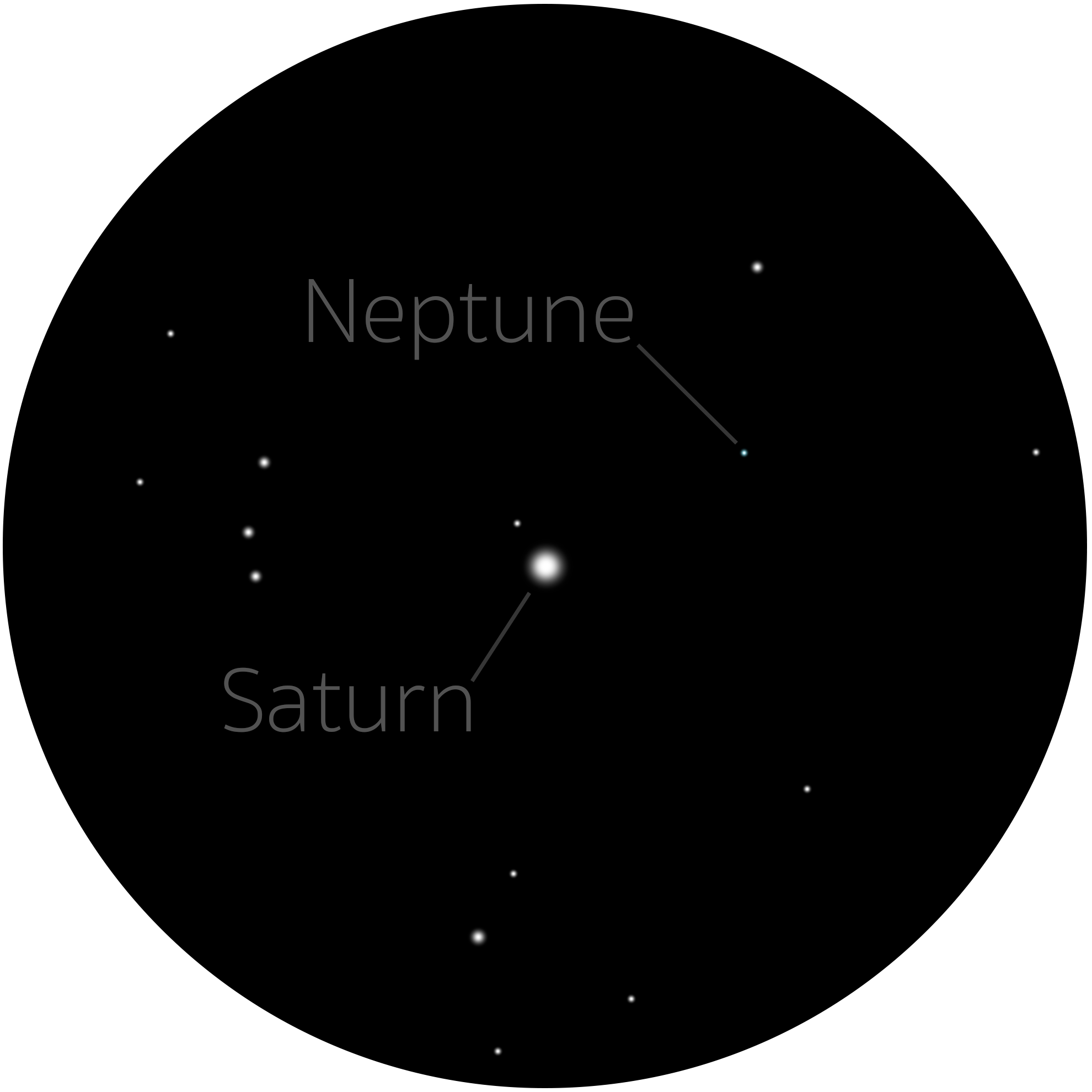
What: Saturn, the ringed planet, meets Neptune, the furthest planet
When: Wednesday to Saturday, February 18-21, approx. 1.5 hours to 2 hours after sunset
Equipment needed:Telescope (recommendations: Starsense Explorer LT 80AZ or Starsense Explorer LT 114AZ)
How: Look close to the western horizon starting about 1 hour after sunset. With the naked eye, you will see Saturn, looking like a bright star. Once the sky has darkened some more, point your telescope at it and you should see Neptune in the same field of view. Neptune is never visible to the naked eye. Note that there will be several stars in the field of view that are brighter than Neptune, so you can use the above simulation to help you identify the distant planet. Both planets will be low on the horizon, so a clear, unobstructed view is essential to catch this event. They will set not long after Neptune becomes visible. These planets can be observed together through a telescope for a few days before or after the dates above, but these are the times of closest approach.
💛 February 19, PM: Mercury's best evening visibility
What: Mercury, the planet nearest the sun, is at its best evening visibility of the year
When: Thursday February 19, approx. 45 minutes after sunset to approx. 1.5 hours after sunset
Equipment needed: Naked eye or binoculars (recommendations: Cometron 7x50 or Ultima 10x50mm)
How: Mercury is notoriously difficult to see because it always stays close to the sun, moving back and forth between the evening sky and the morning sky. On February 19, its apparent distance from the sun, along with the springtime angle of the ecliptic will make it easier to see. February 19 will be the best, but it should be fairly good for 2-3 days before and after as well. Get a clear view of the horizon toward the west. Start looking near that horizon about 45 minutes after sunset. Venus will be visible earlier, closer to the horizon, because it’s a lot brighter. Mercury will appear after Venus, looking like a fairly bright star in the glow of sunset near the horizon. It will set about 1.5 hours after the sun. This will be visible to the naked eye but binoculars would make it easier to find.
💙 February 23, PM: Moon meets Pleiades
What: The first quarter moon meets with the Pleiades star cluster
When: Monday February 23, starting approx. 1.5 hours after sunset
Equipment needed: Naked eye, binoculars (recommendations: Cometron 7x50 or Ultima 10x50), or telescope (recommendations: Starsense Explorer LT 80AZ or Starsense Explorer LT 114AZ)
How: The first quarter moon will be visible in the blue sky starting in late morning, but you’ll need to wait until darkness (at least 1.5 hours after sunset) to see the Pleiades star cluster near it. After darkness, they will make their way down toward the northwest horizon, where they will set after midnight. Although this can technically be seen with the naked eye, the first quarter moon is fairly bright and could make it challenging to see the Pleiades nearby without binoculars.
💙 Night of February 26–27: Moon meets Jupiter
What: The waxing gibbous moon meets with Jupiter, the king of the planets
When: Night of Thursday to Friday, February 26-27, starting approx. 1.5 hours after sunset
Equipment needed: Naked eye or binoculars (recommendations: Cometron 7x50)
How: The waxing gibbous moon will rise toward the northeast in early afternoon, but you’ll need to wait until darkness to see Jupiter close to it. They will rise higher in the sky for a few hours and keep making their way west until they set in the northwest before sunrise. They'll be close enough to each other to see together in a pair of binoculars, but your naked eye is all you need.
Need some moon magic in your home? Check The Moon Guy Shop!
March |
Back to top |
Is it easy to see?
💙 = Easy
💛 = Medium
❤️️ = Challenging
💙 Night of March 2–3: Total lunar eclipse
Where: North and South America, Asia, Oceania
What: The moon will pass fully inside the umbra (inner shadow) of the Earth, making it turn a deep red or orange colour
When: Night of Monday to Tuesday, March 2 to 3 for North America, time depends on location. Night of March 3 to 4 for Asia, Australia, and New Zealand
Equipment needed: Naked eye, binoculars (recommendations: Cometron 7x50 or Ultima 10x50mm), or telescope (recommendations: Starsense Explorer LT 80AZ or Starsense Explorer LT 114AZ)
How: During a total lunar eclipse, the moon passes fully inside the umbra of the Earth. This means that if you were standing on the moon at that time, the sun would disappear completely behind the Earth. The only sunlight that reaches the moon during the eclipse has been filtered and refracted through the Earth’s atmosphere, giving it a deep red or orange colour. For about an hour leading up to the total eclipse, the umbra will slowly take over the moon, in what is known as the partial phases of the eclipse. During the partial phases, the rest of the moon remains illuminated much more brightly, which can make it challenging to see the red colour until closer to the total eclipse.
Phases of the total lunar eclipse, provided in Pacific Standard Time for the night of March 2 to 3:
- 12:44am PST - Penumbral eclipse begins
- 1:50am PST - Partial eclipse begins
- 3:04am PST - Total eclipse begins
- 4:02am PST - Total eclipse ends
- 5:17am PST - Partial eclipse ends
- 6:23am PST - Penumbral eclipse ends
The penumbral phases are very subtle and difficult to observe, but they can be a good test of your observing skills, and are interesting to photograph and compare with the full moon before the start of the eclipse.
This eclipse is best seen from western North America, East Asia, Australia, New Zealand, and anywhere in the Pacific Ocean, but parts of it can be observed from the rest of North and South America and much of Asia. You can find out more about the specifics and timing on the Time and Date website.
💛 March 5–9, PM: Venus meets Saturn
What: Venus meets Saturn, the ringed planet
When: Thursday to Monday, March 5 to 9, approx. 45 minutes after sunset to 1 hour after sunset
Equipment needed: Naked eye, binoculars (recommendations: Cometron 7x50 or Ultima 10x50mm), or telescope (recommendations: Starsense Explorer LT 80AZ or Starsense Explorer LT 114AZ)
How: Find a clear view of the horizon toward the west. Wait until the sky is fairly dark, at least 45 minutes after sunset. Venus will already be visible shortly after sunset, looking like an extremely bright star. Beside it, once it's dark enough, you’ll see what looks like a bright (but not as bright) star, which is actually Saturn. They will be close enough to see them both together with binoculars, and on March 6-8, you could even see them together in a small telescope.
💙 March 22, PM: Moon meets Pleiades
What: The waxing crescent moon meets with the Pleiades star cluster
When: Sunday March 22, starting approx. 1.5 hours after sunset
Equipment needed: Naked eye or binoculars (recommendation: Cometron 7x50)
How: The waxing crescent moon will be visible in the blue sky starting in late morning, but you’ll need to wait until darkness (at least 1.5 hours after sunset) to see the Pleiades star cluster near it. After darkness, they will make their way down toward the northwest horizon, where they will set after midnight. This can be seen with the naked eye, and if you have binoculars, they may get close enough to each other to see them together in the later part of the evening.
💙 Night of March 25–26, PM: Moon meets Jupiter
What: The waxing gibbous moon meets with Jupiter, the king of the planets
When: Night of Wednesday to Thursday, March 25 to 26, starting approx. 1.5 hours after sunset
Equipment needed: Naked eye or binoculars (recommendation: Cometron 7x50)
How: The waxing gibbous moon will rise toward the northeast around midday, but you’ll need to wait until darkness to see Jupiter close to it, at which point they will be very high in the sky. They will make their way down toward the northwest, where they will set in the early hours of the morning. In the later part of the night, they'll be close enough to each other to see together in a pair of binoculars, but your naked eye is all you need.
Need some moon magic in your home? Check The Moon Guy Shop!
April |
Back to top |
Is it easy to see?
💙 = Easy
💛 = Medium
❤️️ = Challenging
💙 April 18, PM: Moon meets Venus
What: The waxing crescent moon meets with Venus, the brightest planet
When: Saturday, April 18, about 30 minutes after sunset until about 2 hours after sunset
Equipment needed: Naked eye
How: The very thin waxing crescent moon will be just to the right of the bright Venus after sunset. It's such a young crescent that Venus may actually be visible before the moon. Look for what looks like a very bright star toward the west after sunset. You might need to wait for the sky to darken a bit to spot the delicate crescent moon to the right of Venus. They will set together about two hours after the sun.
💙 April 22, PM: Moon meets Jupiter
What: The waxing crescent moon meets with Jupiter, the king of the planets
When: Wednesday April 22, starting approx. 1.5 hours after sunset
Equipment needed: Naked eye
How: The thick waxing crescent moon will rise toward the northeast in mid-morning, but you’ll need to wait until darkness to see Jupiter close to it, at which point they will be very high in the sky. They will make their way down toward the northwest, where they will set around 2am. This is mostly a naked eye observation, but in the earlier part of the night, they'll be close enough to each other to see together in a pair of binoculars.
❤️️ April 22–24, PM: Venus meets Uranus
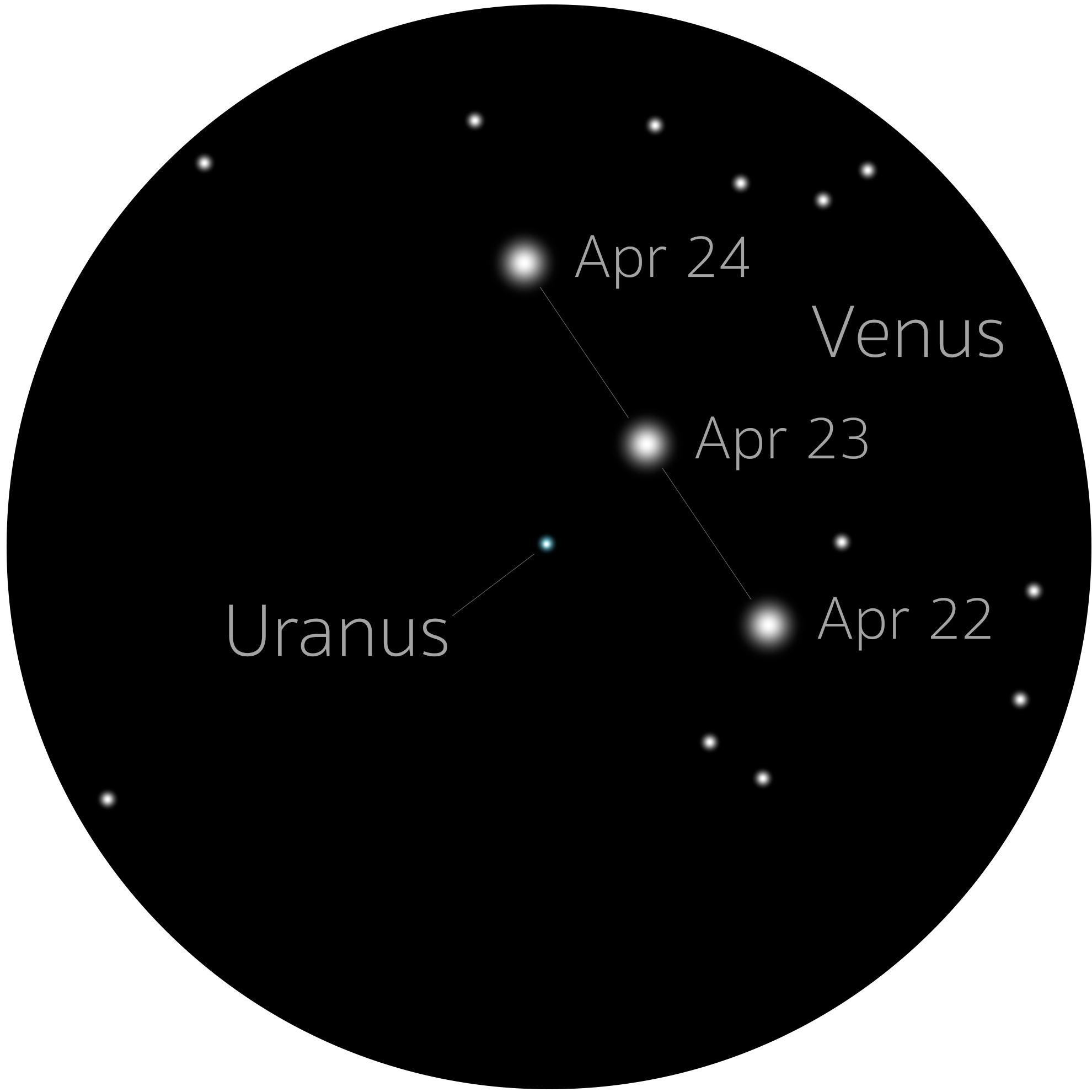
What: Venus meets Uranus, the second furthest planet
When: Wednesday to Friday, April 22 to 24, approx. 1.5 hours after sunset to 2 hours after sunset
Equipment needed: Binoculars (recommendations: Cometron 7x50 or Ultima 10x50mm), or telescope (recommendations: Starsense Explorer LT 80AZ or Starsense Explorer LT 114AZ)
How: Find a clear view of the horizon between the west and northwest directions. Venus will be visible shortly after sunset in that direction, looking like an extremely bright star. Once the sky is dark, about an hour and a half after sunset point your binoculars or telescope at Venus, and you should see Uranus in the same field of view, looking like a faint star. Note that there will be many stars of similar brightness in the same field of view, so you can use the simulation above (simulating the approximate field of view of 8x binoculars) to spot which one is Uranus. As a bonus, the Pleiades cluster will be quite close as well, to the right of Venus. They can probably be seen together with Venus, in the same field of view of wide binoculars, but not quite with a telescope.
Need some moon magic in your home? Check The Moon Guy Shop!
May |
Back to top |
Is it easy to see?
💙 = Easy
💛 = Medium
❤️️ = Challenging
💙 May 18, PM: Moon meets Venus
What: The waxing crescent moon meets with Venus, the brightest planet
When: Monday, May 18, about 30 minutes after sunset until about 2.5 hours after sunset
Equipment needed: Naked eye or binoculars (recommendations: Cometron 7x50 or Ultima 10x50mm)
How: The thin waxing crescent moon will be just above or to the right of the bright Venus after sunset. Look for what looks like a very bright star very close to the young crescent moon toward the west after sunset. They will set together about two and a half hours after the sun. It'll be a dazzling sight with the naked eye, but any binoculars would bring it in even closer and brighter.
💙 May 19, PM: Moon meets Jupiter
What: The waxing crescent moon meets with Jupiter, the king of the planets
When: Tuesday May 19, starting approx. 1.5 hours after sunset
Equipment needed: Naked eye
How: The waxing crescent moon will be visible toward the west shortly after sunset, but you’ll need to wait until darkness to see Jupiter to the left of the moon. They will keep making their way down toward the northwest, where they will set after midnight.
💙 May 22, PM: Moon meets Regulus
What: The first quarter moon meets with Regulus, the brightest star in the Leo constellation
When: Friday May 22, starting approx. 1.5 hours after sunset
Equipment needed: Naked eye, binoculars (recommendations: Cometron 7x50 or Ultima 10x50), or telescope (recommendations: Starsense Explorer LT 80AZ or Starsense Explorer LT 114AZ)
How: The first quarter moon will be visible in the blue sky starting in midday, but you’ll need to wait until darkness (at least 1.5 hours after sunset) to see Regulus near it. After darkness, they will make their way down toward the northwest horizon, where they will set after midnight. This can be seen with the naked eye, but the first quarter moon is fairly bright, so a pair of binoculars or a small telescope would make it easier to see Regulus.
💛 Night of May 30–31: Full moon meets Antares
What: The full moon meets with Antares, the brightest star in the Scorpius constellation
When: Night of Saturday to Sunday, May 30 to 31, starting approx. 1.5 hours after sunset
Equipment needed: Binoculars (recommendations: Cometron 7x50 or Ultima 10x50)
How: The full moon will rise toward the southeast around the time of sunset, but you’ll need to wait until darkness (at least 1.5 hours after sunset) to see Antares near it. The full moon is very bright compared to Antares, so you'll likely need binoculars to be able to see the two together. After darkness, they will make their way across the southern sky toward the southwest horizon, where they will set around the time of sunrise.
Need some moon magic in your home? Check The Moon Guy Shop!
June |
Back to top |
Is it easy to see?
💙 = Easy
💛 = Medium
❤️️ = Challenging
💙 June 6–11, PM: Venus meets Jupiter
What: Venus, the brightest planet, meets with Jupiter, the king of the planets
When: Saturday to Thursday, June 6 to 11, approx. 1 hour after sunset until 2.5 hours after sunset
Equipment needed: Naked eye or binoculars (recommendations: Cometron 7x50 or Ultima 10x50mm)
How: Venus will be visible toward the west shortly after sunset, but you’ll need to wait until the sky gets darker to see Jupiter close to it. Once you see what looks like a pair of very bright stars together, the brighter of the two is Venus. They will keep making their way down toward the northwest, where they will set a few hours after the sun.
💙 June 10, AM: Moon meets Saturn
What: The waning crescent moon meets Saturn, the ringed planet
When: Wednesday June 10, approx. 2.5 hours before sunrise to 1.5 hours before sunrise
Equipment needed: Naked eye
How: The thick waning crescent moon will rise toward the east about 3 hours before the sun, followed by Saturn below it. The view will be better about an hour after they rise, when they're higher above the thick atmosphere. The moon will remain visible after sunrise, but Saturn will fade out of sight as the light of dawn shows up.
💛 June 15, PM: Mercury's best evening visibility
What: Mercury, the planet nearest the sun, is at its best evening visibility of the year
When: Monday June 15, approx. 45 minutes after sunset to approx. 1.5 hours after sunset
Equipment needed: Naked eye or binoculars (recommendations: Cometron 7x50 or Ultima 10x50mm)
How: Mercury is notoriously difficult to see because it always stays close to the sun, moving back and forth between the evening sky and the morning sky. On June 15, its apparent distance from the sun, along with the reasonably good angle of the ecliptic will make it easier to see. June 15 will be the best, but it should be fairly good for 2-3 days before and after as well. Get a clear view of the horizon toward the west. Start looking near that horizon about 45 minutes after sunset. Venus and Jupiter will be visible earlier, higher in the sky, because they're a lot brighter. Mercury will appear after Venus and Jupiter, looking like a fairly bright star in the glow of sunset near the horizon. It will set about 1.5 hours after the sun. This will be visible to the naked eye but binoculars would make it easier to find.
💙 June 16–17, PM: Moon meets Venus, Jupiter, and Mercury
What: The waxing crescent moon meets with Venus, Jupiter, and Mercury
When: Tuesday and Wednesday, June 16 and 17, starting approx. 1 hour after sunset
Equipment needed: Naked eye or binoculars (recommendations: Cometron 7x50 or Ultima 10x50mm)
How: These four celestial jewels will slowly appear one at a time between the west and northwest directions as the sunset light fades. The first to appear - because they're the brightest - will be the moon and Venus, and the order depends on a number of factors. Then, Jupiter will fade into view as the sky continues to darken. And finally, Mercury will show itself. You won't be able to see them all together with binoculars, but you can probably get the moon and Jupiter in a single field of view on June 16, and the moon and Venus together on June 17. The order of the planets, from lowest to highest in the sky, will be Mercury, Jupiter, and Venus.
Need some moon magic in your home? Check The Moon Guy Shop!
July |
Back to top |
Is it easy to see?
💙 = Easy
💛 = Medium
❤️️ = Challenging
❤️️ July 4, AM: Mars meets Uranus
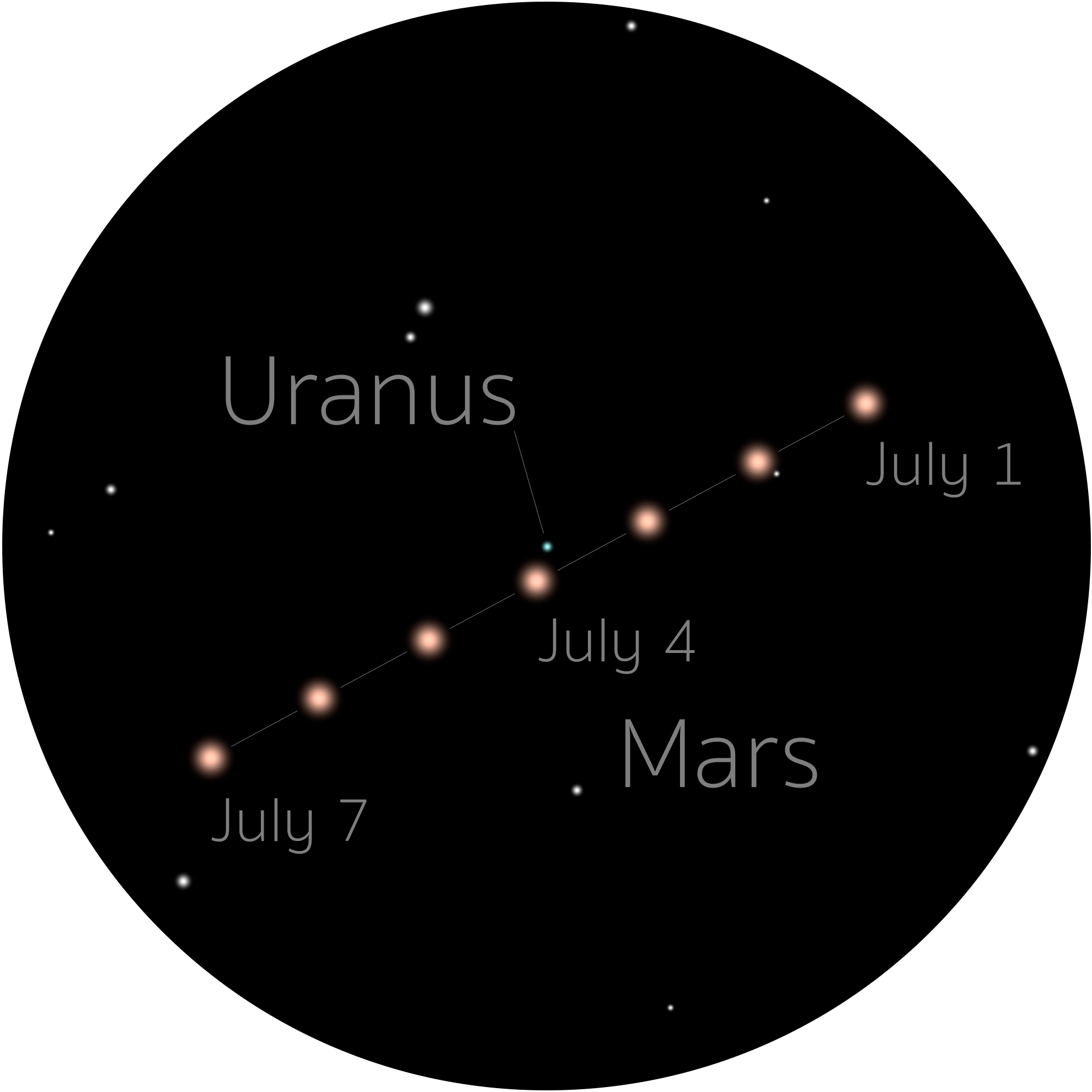
What: Mars meets Uranus, the second furthest planet
When: Saturday July 4, approx. 2 hours before sunrise to 1.5 hours before sunrise
Equipment needed: Binoculars (recommendations: Cometron 7x50 or Ultima 10x50mm), or telescope (recommendations: Starsense Explorer LT 80AZ or Starsense Explorer LT 114AZ)
How: Find a clear view of the horizon between the east and northeast directions. You will see Mars very close to the horizon starting about 2 hours before sunrise, looking like a bright star, possibly with a slightly red hue. Once it's a little higher in the sky, but before the light of dawn starts to appear, point your binoculars or telescope at Mars and you should see Uranus in the same field of view. Note that there will be many stars of similar brightness in the same field of view, so you can use the simulation above (simulating the approximate field of view of 8x binoculars) to spot which one is Uranus. They will come very close together on July 4, at which point you could use fairly high power in your telescope, but they will spend a few days within shot of binoculars.
💙 July 7, AM: Moon meets Saturn
What: The third quarter moon meets Saturn, the ringed planet
When: Tuesday July 7, approx. 1am to 1.5 hours before sunrise
Equipment needed: Naked eye
How: The third quarter moon will rise toward the east around 1am, followed by Saturn below it. The view will be better about an hour after they rise, when they're higher above the thick atmosphere. The moon will remain visible after sunrise, but Saturn will fade out of sight as the light of dawn shows up. Note that this is in the night of July 6-7, not 7-8.
💙 July 11, AM: Moon meets Mars, Pleiades, Hyades
What: The waning crescent moon meets Mars and two star clusters: the Pleiades and Hyades
When: Saturday July 11, approx. 2 hours before sunrise to 1.5 hours before sunrise
Equipment needed: Naked eye
How: The waning crescent moon will rise toward the northeast about 3 hours before the sun, with the Pleiades near it. In the next hour, Mars will rise below the moon, followed by the Hyades cluster below Mars. The Pleiades and Hyades clusters will be the first to disappear with the light of dawn, followed by Mars, while the moon will likely be visible until sunrise.
💙 July 16–17, PM: Moon meets Venus
What: The waxing crescent moon meets with Venus
When: Thursday and Friday, July 16 and 17, approx. 30 minutes to 1 hour after sunset
Equipment needed: Naked eye
How: Look toward the west after sunset and you should see Venus, looking like a very bright star, show up near the horizon, with the crescent moon nearby. The moon will be to the right of Venus on July 16 and to the left on July 17.
Need some moon magic in your home? Check The Moon Guy Shop!
August |
Back to top |
Is it easy to see?
💙 = Easy
💛 = Medium
❤️️ = Challenging
💙 August 1–20: Perseid meteor shower peaks Aug 13
Arguably the best meteor shower of the year, the Perseids certainly put on a show of shooting stars annually. On its orbit around the sun, the Earth slams into debris left by comet Swift-Tuttle once a year and those little bits of comet are what we observe as shooting stars!
The meteor shower technically starts around July 17th, but I’ve always found that the beginning of August is when it starts to become obvious. They gradually increase in intensity until the peak around the night of August 13, after which point they decrease more quickly. If you really want a good show, it’s best to go as close to August 13th, but a day or two before or after should still give a great view.
Go as far away from city lights as you can and find a spot where you can lie down with lots of blankets and pillows, with a wide open view of the sky. Look up and wait. You can try to see them in the evening, but they tend to get better between midnight and dawn. They can be seen in any part of the sky, but will all appear to emanate from the constellation of Perseus.
2026 is an ideal year for the Perseids because the new moon is on August 12. This means the sky will be very dark during the peak of the shower, without moonlight to interfere with the smaller meteors!
💛 August 7, AM: Moon occults Pleiades
What: The waning crescent moon passes in front of the bright Pleiades star cluster
When: Friday August 7, early morning (exact time depends on location)
Equipment needed: Naked eye, binoculars (recommendations: Cometron 7x50 or Ultima 10x50mm), or telescope (recommendations: Starsense Explorer LT 80AZ or Starsense Explorer LT 114AZ)
How: Check an astronomy app like Stellarium to see if the occultation is visible from your location.
Once you’ve determined that it’ll be visible from your area, find a location away from light pollution. The moon will rise around midnight in the night of August 6-7 in the northeast, but the Pleiades cluster will not be visible until they are higher in the sky. The moon will pass in front of the star cluster sometime before dawn, depending on your location. To find the exact timing of the occultation, use an app like Stellarium. Centre on the moon, go to August 7 in the morning, and move backward in time by hours and minutes to see when the Pleiades appear to move behind the moon and reappear. Note that the disappearance or reappearance will only be visible if the objects are above the horizon but the sun is below the horizon. If the sun is not far below the horizon, it may be possible to see but difficult because of the bright dawn light.
Note that the thick crescent moon is brighter than the Pleiades, and binoculars or a telescope would make the observation easier.
If the occultation is not visible from your location, it will be a close conjunction of the moon and Pleiades. Look at the moon anytime in the night of August 6-7 to see the two celestial objects together.
💙 August 9, AM: Moon meets Mars
What: The waning crescent moon meets Mars, the red planet
When: Sunday August 9, approx. 2am to 1.5 hours before sunrise
Equipment needed: Naked eye
How: The waning crescent moon will rise toward the northeast around 2am, accompanied by Mars nearby. The view will be better about an hour after they rise, when they're higher above the thick atmosphere. The moon will remain visible after sunrise, but Mars will fade out of sight as the light of dawn shows up.
💛 August 11, AM: Moon meets Mercury
What: The thin waning crescent moon meets Mercury, the fastest planet
When: Tuesday August 11, approx. 1.5 hours before sunrise to 1 hour before sunrise
Equipment needed: Naked eye or binoculars (recommendations: Cometron 7x50 or Ultima 10x50mm)
How: The thin waning crescent moon will rise toward the northeast about 1.5 hour before sunrise, accompanied by Mercury nearby. There's only about a half hour window for them to rise higher above the thick atmosphere before there's too much dawn light to see them. If you have binoculars, they would make it a lot easier to see the two celestial objects together. The moon will be very thin, so like Mercury, it will fade out of sight as the light of dawn shows up.
💛 August 12: Total solar eclipse
Where: Greenland, Iceland, and Spain
What: The moon will pass directly in front of the sun, creating a total solar eclipse for a certain parts of the world
When: Wednesday August 12, times vary depending on location
Equipment needed: Solar eclipse glasses, solar binoculars, or solar telescope. Never look directly at the sun without certified solar viewing filters, even during the partial or annular phase of an eclipse.
How: Observers in certain regions of Greenland, Iceland, and Spain will be able to view a total solar eclipse. Observers in the rest of Europe, some of northern Africa, much of Canada, and a small portion of the eastern United States will be able to view a partial solar eclipse, depending on exact location. See this Time and Date page for more info on this eclipse.
A total solar eclipse happens when the moon passes exactly in front of the sun as seen from certain parts of the world, which briefly turns the day into night for those regions. When this happens, much bigger areas experience a partial solar eclipse. This will make it look like the moon is taking a bite out of the sun.
💛 August 15, AM: Jupiter meets Mercury
What: Jupiter, the king of the planets, meets Mercury, the fastest planet
When: Saturday August 15, approx. 1 hour before sunrise to 45 minutes before sunrise
Equipment needed: Naked eye, binoculars (recommendations: Cometron 7x50 or Ultima 10x50mm), or telescope (recommendations: Starsense Explorer LT 80AZ or Starsense Explorer LT 114AZ)
How: Jupiter and Mercury will rise together between the east and northeast about an hour before the sun, looking like two bright stars. The main challenge with this observation will be the light of dawn that will be creeping in at the same time as they rise. For this reason, finding the clearest possible horizon toward the east and northeast is important. You should be able to see these with your naked eye, but that could depend on atmospheric conditions. Binoculars or a small telescope would make this observation a lot easier. The two planets will fade out of sight as the light of dawn shows up.
💛 August 15, PM: Moon meets Venus
What: The waxing crescent moon meets with Venus
When: Saturday August 15, approx. 30 minutes to 45 minutes after sunset
Equipment needed: Binoculars (recommendations: Cometron 7x50 or Ultima 10x50mm)
How: Look very close to the horizon between the west and southwest after sunset and you should see Venus, looking like a very bright star, with the crescent moon below it. You may be able to spot these with your naked eye, but binoculars would make it a lot easier, especially if your atmosphere is not perfectly clear.
💙 Night of August 27–28: Partial lunar eclipse
Where: North and South America, Africa, Europe, Antarctica
What: The moon will pass partially inside the umbra (inner shadow) of the Earth, making a large portion of it turn a deep red or orange colour
When: Night of Thursday to Friday, August 27 to 28, time depends on location
Equipment needed: Naked eye, binoculars (recommendations: Cometron 7x50 or Ultima 10x50mm), or telescope (recommendations: Starsense Explorer LT 80AZ or Starsense Explorer LT 114AZ)
How: During a partial lunar eclipse, the moon passes partially inside the umbra of the Earth. This means that if you were standing on certain parts of the moon at that time, the sun would disappear completely behind the Earth. The only sunlight that reaches those parts of the moon during the eclipse has been filtered and refracted through the Earth’s atmosphere, giving it a deep red or orange colour. In a partial eclipse, there is part of the moon that is still receiving direct sunlight. For about an hour leading up to the total eclipse, the umbra will slowly take over the moon. The red or orange colouring becomes more obvious near the maximum of the eclipse, when there is less of the moon that is reflecting direct sunlight.
Phases of the partial lunar eclipse, provided in Eastern Daylight Time for the night of August 27 to 28:
- 9:23pm EDT - Penumbral eclipse begins
- 10:33pm EDT - Partial eclipse begins
- 12:12am EDT - Maximum partial eclipse
- 1:51am EDT - Partial eclipse ends
- 3:01am EDT - Penumbral eclipse ends
The penumbral phases are very subtle and difficult to observe, but they can be a good test of your observing skills, and are interesting to photograph and compare with the full moon before the start of the eclipse.
This entire eclipse can be seen from South America, eastern North America, and Antarctica, but parts of it can be observed from the rest of North and South America, Africa, and Europe. You can find out more about the specifics and timing on the Time and Date website.
💙 Night of August 30–31: Moon meets Saturn
What: The waning gibbous moon meets Saturn, the ringed planet
When: Night of Sunday to Monday, August 30 to 31, approx. 2 hours after sunset to 1.5 hours before sunrise
Equipment needed: Naked eye
How: The waning gibbous moon will rise toward the east about an hour after sunset, followed by Saturn below it. The view will be better about an hour after they rise, when they're higher above the thick atmosphere. The moon will remain visible after sunrise, but Saturn will fade out of sight as the light of dawn shows up.
Need some moon magic in your home? Check The Moon Guy Shop!
September |
Back to top |
Is it easy to see?
💙 = Easy
💛 = Medium
❤️️ = Challenging
💛 September 3, AM: Moon occults Pleiades
What: The waning gibbous moon passes in front of the bright Pleiades star cluster
When: Thursday September 3, early morning (exact time depends on location)
Equipment needed: Naked eye, binoculars (recommendations: Cometron 7x50 or Ultima 10x50mm), or telescope (recommendations: Starsense Explorer LT 80AZ or Starsense Explorer LT 114AZ)
How: Check an astronomy app like Stellarium to see if the occultation is visible from your location.
Once you’ve determined that it’ll be visible from your area, find a location away from light pollution. The moon will rise a couple of hours after sunset on September 2 in the northeast, but the Pleiades cluster will not be visible until they are higher in the sky. The moon will pass in front of the star cluster sometime before dawn, depending on your location. To find the exact timing of the occultation, use an app like Stellarium. Centre on the moon, go to September 3 in the morning, and move backward in time by hours and minutes to see when the Pleiades appear to move behind the moon and reappear. Note that the disappearance or reappearance will only be visible if the objects are above the horizon but the sun is below the horizon. If the sun is not far below the horizon, it may be possible to see but difficult because of the bright dawn light.
Note that the gibbous moon is a lot brighter than the Pleiades, and binoculars or a telescope would make the observation easier.
If the occultation is not visible from your location, it will be a close conjunction of the moon and Pleiades. Look at the moon anytime in the night of September 2 to 3 to see the two celestial objects together.
💙 September 6, AM: Moon meets Mars
What: The waning crescent moon meets Mars, the red planet
When: Sunday September 6, approx. 2am to 1.5 hours before sunrise
Equipment needed: Naked eye
How: The waning crescent moon will rise toward the northeast around 1am, followed by Mars below. The view will be better about an hour after they rise, when they're higher above the thick atmosphere. The moon will remain visible after sunrise, but Mars will fade out of sight as the light of dawn shows up.
💙 September 8, AM: Moon meets Jupiter
What: The waning crescent moon meets with Jupiter, the king of the planets
When: Tuesday September 8, starting approx. 2 hours before sunrise to 1.5 hours before sunrise
Equipment needed: Naked eye or binoculars (recommendations: Cometron 7x50 or Ultima 10x50mm)
How: The waning crescent moon will rise between the east and northeast about three hours before sunrise, followed by Jupiter below it. They will become easier to see once they're higher in the sky, about two hours before sunrise. Both will become harder to see as the light of dawn starts to fade in.
💙 Night of September 26-27: Full moon meets Saturn
What: The full moon meets Saturn, the ringed planet
When: Night of Saturday to Sunday, September 26 to 27, approx. 1.5 hours after sunset to 1.5 hours before sunrise
Equipment needed: Naked eye
How: The full moon will rise toward the east right around the time of sunset, followed by Saturn below it, but you'll need to wait for the sky to darken before seeing Saturn. The view will be better about an hour and a half after they rise, when they're higher above the thick atmosphere and the sky is dark. They will make their way across the sky toward the west all night long. The moon will remain visible for a short while after sunrise, before setting in the west, but Saturn will fade out of sight as the light of dawn shows up.
Need some moon magic in your home? Check The Moon Guy Shop!
October |
Back to top |
Is it easy to see?
💙 = Easy
💛 = Medium
❤️️ = Challenging
💙/💛 October 5, AM: Moon meets Mars and Beehive Cluster
What: The waning crescent moon meets Mars and the Beehive star cluster
When: Monday October 5, approx. 2am to 1.5 hours before sunrise
Equipment needed: Naked eye, binoculars (recommendations: Cometron 7x50 or Ultima 10x50mm), or telescope (recommendations: Starsense Explorer LT 80AZ or Starsense Explorer LT 114AZ)
How: The waning crescent moon will rise toward the northeast around 1am, with Mars nearby. You should be able to see those two with the naked eye or binoculars shortly after they rise, but the view will be better about an hour later, when they're higher above the thick atmosphere. That's also when the Beehive star cluster will start to become more visible. It is not a very bright cluster, so the light of the moon, or any light pollution around you, could make it hard to see the Beehive without binoculars or a telescope. At a certain moment of the early morning, the moon will actually pass directly in front of the Beehive, but the time will depend on your location. The moon will remain visible after sunrise, but Mars and the Beehive will fade out of sight as the light of dawn shows up.
💙 October 6, AM: Moon occults Jupiter
What: The waning crescent moon passes in front of Jupiter, the king of the planets
When: Tuesday October 6, early morning (exact time depends on location)
Equipment needed: Naked eye, binoculars (recommendations: Cometron 7x50 or Ultima 10x50mm), or telescope (recommendations: Starsense Explorer LT 80AZ or Starsense Explorer LT 114AZ)
How: Check an astronomy app like Stellarium to see if the occultation is visible from your location.
Once you’ve determined that it’ll be visible from your area, find a location away from light pollution. The moon will rise around 3am on October 6 between the east and northeast, with the bright Jupiter close to it. The moon will pass in front of the planet sometime before dawn, depending on your location. To find the exact timing of the occultation, use an app like Stellarium. Centre on the moon, go to October 6 in the morning, and move backward in time by hours and minutes to see when Jupiter appears to move behind the moon and reappear. Note that the disappearance or reappearance will only be visible if the objects are above the horizon but the sun is below the horizon. If the sun is not far below the horizon, it may be possible to see but difficult because of the bright dawn light.
This can easily be observed with your naked eye, but binoculars or a telescope would make the observation a lot brighter and more detailed.
If the occultation is not visible from your location, it will be a close conjunction of the moon and Jupiter. Look at the moon anytime in the pre-dawn hours of October 6 to see the two celestial objects together.
💛 October 10-12, AM: Mars meets Beehive Cluster
What: Mars, the red planet, meets the Beehive star cluster
When: Saturday to Monday, October 10-12, approx. 2am to 1.5 hours before sunrise
Equipment needed: Binoculars (recommendations: Cometron 7x50 or Ultima 10x50mm) or telescope (recommendations: Starsense Explorer LT 80AZ or Starsense Explorer LT 114AZ)
How: Mars will rise toward the northeast around 1am, looking like an average star. Wait until at least 2am when it's higher above the thick atmosphere. From very dark skies, you may be able to see the Beehive Cluster with your naked eye, looking like a faint fuzzy patch of light close to or around Mars. If you have any light pollution around you, you will need to use binoculars or a small telescope to see the stars of the Beehive Cluster. On October 11, Mars will actually be within the star cluster, but they'll be close to each other for a few nights before and after. The best time to view them will be about two hours before sunrise, when they're higher in the sky. They will then fade out of sight as the light of dawn shows up.
At this time, Mars is not excessively bright, so it can easily be mistaken for a star. You can use an application like Stellarium to help you spot Mars. However, I recommend against using the pointing feature because it's not always accurate. Instead, use it to locate Mars's position relative to bright stars and constellations you know, and then look at the sky to identify it.
💙 October 15-27: Orionid meteor shower peaks Oct 21
What: The Earth will pass through debris left by comet Halley, creating the Orionid meteor shower
When: October 15-27, all night (approx. 1.5 hours after sunset to 1.5 hours before sunrise)
Equipment needed: Naked eye
How: The meteor shower technically starts around October 2nd, but I find that mid-October is when it starts to become obvious. They gradually increase in intensity until the peak around the night of October 21, after which point they decrease over the next few days. If you really want a good show, it’s best to go as close to October 21, but a day or two before or after should still give a great view.
Go as far away from city lights as you can and find a spot where you can lie down with lots of blankets and pillows, with a wide open view of the sky. Look up and wait. You can try to see them in the evening, but they tend to get better between midnight and dawn. They can be seen in any part of the sky, but will all appear to emanate from the constellation of Orion.
2026 is not the best year for the Orionids because they peak during the waxing gibbous moon, which can obscure the smaller meteors. If you go a couple of days before the peak, the moon will set earlier, which could give you a chance to see more meteors, but the peak of activity may outweigh the increasing light of the moon around October 21.
💙 Night of October 23-24: Moon meets Saturn
What: The waxing gibbous moon meets Saturn, the ringed planet
When: Night of Friday to Saturday, October 23 to 24, approx. 1.5 hours after sunset to 2.5 hours before sunrise
Equipment needed: Naked eye
How: The waxing gibbous moon will rise toward the east about an hour before sunset, followed by Saturn below it, but you'll need to wait for the sky to darken before seeing Saturn. The view will be better about an hour and a half after sunset, when they're higher above the thick atmosphere and the sky is dark. They will make their way across the sky toward the west all night long, getting closer to each other later in the night. They will set together toward the west about two hours before sunrise.
💛 October 27, PM: Moon occults Pleiades
What: The waning gibbous moon passes in front of the bright Pleiades star cluster
When: Tuesday October 27, evening (exact time depends on location)
Equipment needed: Binoculars (recommendations: Cometron 7x50 or Ultima 10x50mm), or telescope (recommendations: Starsense Explorer LT 80AZ or Starsense Explorer LT 114AZ)
How: Check an astronomy app like Stellarium to see if the occultation is visible from your location.
Once you’ve determined that it’ll be visible from your area, find a location away from light pollution. The moon will rise shortly after sunset on October 27 in the northeast, but the Pleiades cluster will not be visible until they are higher in the sky. The moon will pass in front of the star cluster sometime in the evening, depending on your location. To find the exact timing of the occultation, use an app like Stellarium. Centre on the moon, go to October 27 in the evening, and move forward in time by hours and minutes to see when the Pleiades appear to move behind the moon and reappear. Note that the disappearance or reappearance will only be visible if the objects are above the horizon but the sun is below the horizon. If the sun is not far below the horizon, it may be possible to see but difficult because of the bright dawn light.
Note that the gibbous moon is a lot brighter than the Pleiades, and binoculars or a telescope would make the observation much easier.
If the occultation is not visible from your location, it will be a close conjunction of the moon and Pleiades. Look at the moon anytime in the night of October 27 to 28 to see the two celestial objects together.
Need some moon magic in your home? Check The Moon Guy Shop!
November |
Back to top |
Is it easy to see?
💙 = Easy
💛 = Medium
❤️️ = Challenging
💙 November 2, AM: Moon meets Mars and Jupiter
What: The third quarter moon meets Mars and Jupiter
When: Monday November 2, approx. 1am to 1.5 hours before sunrise
Equipment needed: Naked eye, binoculars (recommendations: Cometron 7x50 or Ultima 10x50mm), or telescope (recommendations: Starsense Explorer LT 80AZ or Starsense Explorer LT 114AZ)
How: The third quarter moon will rise toward the northeast around midnight, shortly followed by Mars, and then Jupiter. Once they've all risen, you'll be able to see all three celestial bodies, but the view will be better about an hour later, when they're higher above the thick atmosphere. All three objects can be seen with the naked eye, but if you have binoculars, you can view the moon and Mars in the same field of view. At a certain part of the early morning, they will be close enough to each other to see together in a telescope, but the specific time will depend on your location. Jupiter, the brighter of the two planets, will remain a little too far to be seen with the others using an optical instrument. The moon will remain visible after sunrise, but the planets will fade out of sight as the light of dawn shows up.
💙/❤️️ November 7, AM: Moon meets Venus and Spica
What: The waning crescent moon meets Venus and Spica
When: Saturday November 7, approx. 1.5 hours to 1 hour before sunrise
Equipment needed: Naked eye or binoculars (recommendations: Cometron 7x50 or Ultima 10x50mm)
How: Venus, the brightest planet, will rise between the east and southeast about an hour and a half before the sun, with Spica, the brightest star in the Virgo constellation. The moon will rise shortly after, below Venus and Spica. The exact alignment will depend on your location. Venus and the moon will be easy to see for at least half an hour after they rise, but Spica will quickly disappear in the light of dawn. All three objects can be seen with the naked eye, but if you have binoculars, you can view them up close in the same field of view. After Spica has succumbed to the light of dawn, the crescent moon is likely to be the next one to become invisible, leaving Venus to shine as the "Morning Star" until shortly before sunrise.
💙 November 13-17, AM: Jupiter meets Mars
What: Jupiter, the king of the planets, meets Mars, the red planet
When: Friday to Tuesday, November 13-17, approx. 12:30am to 1.5 hours before sunrise
Equipment needed: Naked eye, binoculars (recommendations: Cometron 7x50 or Ultima 10x50mm), or telescope (recommendations: Starsense Explorer LT 80AZ or Starsense Explorer LT 114AZ)
How: Jupiter and Mars will rise together toward between the east and northeast a little before midnight. You'll be able to see both shortly after they've risen, but the view will be better about an hour later, when they're higher above the thick atmosphere. They can both be seen with the naked eye, but if you have binoculars or a telescope, you can view them up close in the same field of view for a few days around their closest approach on November 16. They will be fairly close to each other for a few more days before and after the above dates, at which point you can view them with the naked eye or binoculars. They will fade out of sight as the light of dawn shows up.
💛 November 20, AM: Mercury's best morning visibility
What: Mercury, the smallest and fastest-moving planet, is at its best morning visibility of the year
When: Friday November 20, approx. 1.5 hours to approx. 45 minutes before sunrise
Equipment needed: Naked eye or binoculars (recommendations: Cometron 7x50 or Ultima 10x50mm)
How: Mercury is notoriously difficult to see because it always stays close to the sun, moving back and forth between the evening sky and the morning sky. On November 20, its apparent distance from the sun, along with the autumn angle of the ecliptic will make it easier to see. November 20 will be the best, but it should be fairly good for 2-3 days before and after as well. Get a clear view of the east to southeast horizon. Start looking for the rise of Mercury near that horizon a little more than 1.5 hours before sunrise. The much brighter Venus will already be higher in the southeast. When Mercury rises, it will look like a fairly bright star in the glow of sunrise near the horizon. It will rise higher as the morning progresses, but the sky will get brighter, eventually making Mercury impossible to see. This will be visible to the naked eye but binoculars would make it easier to find.
💙 November 20, PM: Moon meets Saturn
What: The waxing gibbous moon meets Saturn, the ringed planet
When: Friday November 20, approx. 1.5 hours after sunset to 2am
Equipment needed: Naked eye
How: The waxing gibbous moon will rise toward the east in mid afternoon, followed by Saturn below it, but you'll need to wait for the sky to darken before seeing Saturn. The view will be better about an hour and a half after sunset, when they're higher above the thick atmosphere and the sky is dark. They will make their way across the sky toward the west all night long, getting further from each other as the night progresses. Saturn will set first a little after 2am, followed by the moon about an hour later.
💛 November 24, AM: Full moon occults Pleiades
What: The full moon passes in front of the bright Pleiades star cluster
When: Tuesday November 24, early morning (exact time depends on location)
Equipment needed: Binoculars (recommendations: Cometron 7x50 or Ultima 10x50mm), or telescope (recommendations: Starsense Explorer LT 80AZ or Starsense Explorer LT 114AZ)
How: Check an astronomy app like Stellarium to see if the occultation is visible from your location.
Once you’ve determined that it’ll be visible from your area, find a location away from light pollution. The full moon will rise about an hour before sunset on November 23 in the northeast, but the Pleiades cluster will not be visible until they are higher in the sky and the sky is completely dark. The moon will pass in front of the star cluster sometime in the early morning of November 24, depending on your location. To find the exact timing of the occultation, use an app like Stellarium. Centre on the moon, go to November 24 in the morning, and move backward in time by hours and minutes to see when the Pleiades appear to move behind the moon and reappear. Note that the disappearance or reappearance will only be visible if the objects are above the horizon but the sun is below the horizon. If the sun is not far below the horizon, it may be possible to see but difficult because of the bright dawn light.
Note that the full moon is a lot brighter than the Pleiades, and binoculars or a telescope would make the observation much easier. The light of the full moon may be too blinding to see the Pleiades without an optical instrument.
If the occultation is not visible from your location, it will be a close conjunction of the moon and Pleiades. Look at the moon anytime in the night of November 23 to 24 to see the two celestial objects together.
💙 Night of November 29-30: Moon meets Jupiter and Mars
What: The third quarter moon meets Mars and Jupiter
When: Night of Sunday to Monday, November 29 to 30, approx. midnight to 1.5 hours before sunrise
Equipment needed: Naked eye or binoculars (recommendations: Cometron 7x50 or Ultima 10x50mm)
How: The waning gibbous moon will rise between the east and northeast a little before 11pm, with Jupiter beside it, followed by Mars about half an hour later. Once they've all risen, you'll be able to see all three celestial bodies, but the view will be better about an hour later, when they're higher above the thick atmosphere. All three objects can be seen with the naked eye, but if you have binoculars, you can view the moon and Jupiter in the same field of view. The moon will remain visible after sunrise, but the planets will fade out of sight as the light of dawn shows up.
Bonus celestial body in the mix: Regulus, the brightest star in the constellation of Leo, will be between Mars and the moon.
Need some moon magic in your home? Check The Moon Guy Shop!
December |
Back to top |
Is it easy to see?
💙 = Easy
💛 = Medium
❤️️ = Challenging
💙 December 4-5, AM: Moon meets Venus
What: The waning crescent moon meets Venus, the brightest planet
When: Friday and Saturday, December 4 and 5, approx. 3 hours to 45 minutes before sunrise
Equipment needed: Naked eye
How: Venus will rise between the east and southeast about four hours before the sun on both December 4 and 5 . The moon will rise around the same time, to the right of Venus on December 4, and almost an hour later, below Venus on December 5. The exact alignment will depend on your location. They will become brighter as they rise higher in the sky, and will both fade out as the light of dawn appears, though Venus will probably be the last celestial object to remain visible before sunrise, hence its nickname, the "Morning Star”.
💙 December 7-17: Geminid meteor shower peaks Dec 14
Possibly the most active meteor shower of the year, the Geminids are sure to light up the sky every year. The main reason the Perseids are more popular is because they tend to be easier to see, thanks to the warmer weather in August. Unlike most meteor showers’ sources, which are icy comets, the body responsible for the Geminid meteor shower is a rocky comet called 3200 Phaethon. On its orbit around the sun, the Earth slams into debris left by 3200 Phaethon once a year and those little bits of comet are what we observe as shooting stars!
The meteor shower technically starts around December 7th and lasts until the 17th, but this shower is best observed as close to the peak as possible, on the night of December 13 to 14. They can be seen early in the evening all the way until dawn, but the best time to watch them is around 2am, when the constellation of Gemini is straight overhead.
Go as far away from city lights as you can and find a spot where you can lie down with lots of blankets and pillows, with a wide open view of the sky. Look up and wait. They can be seen in any part of the sky, but will all appear to emanate from the constellation of Gemini. This can be a cold time of year and when you’re not moving much, it feels even colder, so I recommend wearing lots of extra warm clothes and packing your favourite hot drink.
2026 is a very good year for this shower since the peak happens during the waxing crescent moon, which sets well before midnight.
💙 December 17, PM: Moon meets Saturn
What: The waxing gibbous moon meets Saturn, the ringed planet
When: Thursday December 17, approx. 1.5 hours after sunset to midnight
Equipment needed: Naked eye
How: The waxing gibbous moon will rise toward the east around midday, followed by Saturn below it, but you'll need to wait for the sky to darken before seeing Saturn. The view will be better about an hour and a half after sunset, when they're higher in the sky and the sky is dark. They will make their way across the sky toward the west all evening long, until they set together after midnight.
💙 December 21, PM: Moon meets Pleiades
What: The waxing gibbous moon meets with the Pleiades star cluster
When: Monday December 21, starting approx. 1.5 hours after sunset
Equipment needed: Naked eye or binoculars (recommendations: Cometron 7x50 or Ultima 10x50)
How: The waxing gibbous moon will rise toward the northeast in mid-afternoon, but you’ll need to wait until darkness (at least 1.5 hours after sunset) to see the Pleiades star cluster near it. They will rise higher in the sky for a few hours and keep making their way west until they set in the northwest before sunrise. They will get further from each other as the night progresses. Although this can technically be seen with the naked eye, the gibbous moon is very bright and could make it challenging to see the Pleiades nearby without binoculars. From some part of eastern North America, this will actually be an occultation of the Pleiades by the moon, and will happen near the moment that the sky gets dark enough to see the Pleiades.
💙 Night of December 26-27: Moon meets Jupiter
What: The waning gibbous moon meets with Jupiter, the king of the planets
When: Night of Saturday to Sunday, December 26 to 27, approx. 5 hours after sunset to 1.5 hours before sunrise
Equipment needed: Naked eye or binoculars (recommendations: Cometron 7x50 or Ultima 10x50mm)
How: The waning gibbous moon will rise between the east and northeast about four hours after sunset, followed by Jupiter below it. They will become easier to see once they're higher in the sky, and will get closer to each other as the night progresses. Jupiter will disappear as the light of dawn starts to fade in, but the moon will remain visible after sunrise.
💙 Night of December 27-28: Moon meets Mars
What: The waning gibbous moon meets Mars, the red planet
When: Night of Sunday to Monday, December 27 to 28, approx. 10pm to 1.5 hours before sunrise
Equipment needed: Naked eye
How: The waning gibbous moon will rise between the east and northeast a little before 10pm, with Mars to its left. They will become easier to see once they're higher in the sky, and will get closer to each other as the night progresses. Mars will disappear as the light of dawn starts to fade in, but the moon will remain visible after sunrise. Jupiter will be in the vicinity as well, looking a fair bit brighter than Mars.
Need some moon magic in your home? Check The Moon Guy Shop!